

In trading, your capital is half the game, and once lost, never returned. Stop Loss One of the best risk mitigation rules to avoid big losses is to apply the stop loss position. But when you’re trying to place a stop loss order that effectively reflects the volatility of the market, rather than a flat percentage or arbitrary number? This is where you can set a stop loss using an Average Daily Range (ADR). Knowing how to place stop losses based on average daily range can greatly improve your trading strategy; it is a more realistic and dynamic approach.
It is the calculation of how much a stock price can move on a given day. Being able to set a stop loss based on the average daily range certainly puts the odds in favor of the trader by allowing you to set logical stop loss levels that are based on what the market is likely to do. This approach also accounts for historical volatility and can prevent you from being stopped out of a trade too soon during normal price swings.
In this post, we delve further into the concept of setting a stop loss order on average daily range, why this technique is effective, and how you can integrate ADR into your trading plan. We will also consider the “average true range”(ATR) and how this indy can help you refine your stop loss settings. So let’s jump into the depths of the market and talk about setting a stop loss using ADR!
What is the Average Daily Range?
The “average daily range” is a method for calculation the difference between daily high and low. It offers traders an insight into the volatility of a security for the observed period, typically calculated over a certain number of trading days.
For instance, if you are looking at a currency pair such as EUR/USD, the ADR will tell you the average daily range over 14 days. It enables you to comprehend the daily price ranges, which can be useful when placing your stop-loss and setting it to a level whereby the price can move naturally, therefore you are less likely to be stopped out prematurely due to random volatility.
By having a stop loss based on the “average daily range”, you are matching your stop with the historical volatility of the underlying asset, so it will not be too tight or too wide. Such synchronisation of your trading strategy with the market’s movement could theoretically help you with managing your risk, also.
How Does ADR Work in Different Markets?
The ADR system is very versatile and can be used on all types of instruments (equities, forex, commodities, cryptocurrencies, etc.). In a volatile market, the number of stops should also be adjusted (the higher the market volatility, ty the fewer the stops).
For instance, if you are trading on the stock market (where the price moves are generally lower -but still, that’s not always the c), you will have a smaller average daily range and hence your stop loss will be tighter. On the flip side, say in volatile markets such as forex or cryptocurrency, the ADR will be higher, and so you can adjust your stop-loss accordingly to cover these costs.
Whether you are trading any asset, ADR can be a great tool for managing risk by providing you with a flexible way to adjust your stop losses based on the unique set of market conditions.
How to Set Stop Loss Based on Average Daily Range
When setting a stop loss based on average daily range, it’s important to factor in both the ADR and the asset’s current market conditions. Here’s a step-by-step guide on how to apply this technique effectively.
1. Calculate the Average Daily Range (ADR)
The first step in setting a stop loss based on ADR is calculating the “average daily range” for the asset you’re trading. To do this, take the highest price and the lowest price of each day over a set period, usually 14 days, and calculate the difference between them. Then, average these values over the selected period.
For example, let’s say you are analyzing a stock that has the following high-low price movements over 5 days:
| Day | High Price | Low Price | Daily Range (High – Low) |
| 1 | 150 | 145 | 5 |
| 2 | 155 | 148 | 7 |
| 3 | 160 | 150 | 10 |
| 4 | 162 | 155 | 7 |
| 5 | 164 | 158 | 6 |
The “average daily range” (ADR) would be:
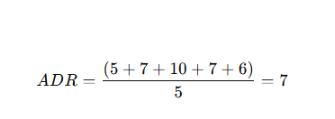
This tells you that on average, the stock moves 7 points per day.
2. Determine the Stop Loss Level
Once you have the ADR, the next step is to determine where to place your stop loss. A common approach is to place the stop loss one or two times the ADR below your entry price for a buy order (or above for a sell order).
- For long positions (buy), subtract the ADR from the entry price to find your stop loss level.
- For short positions (sell), add the ADR to the entry price for the stop loss.
For example, if you entered a long position on the stock at $160, and the ADR is 7, a reasonable stop loss would be placed at $160 – (1 x 7) = $153.
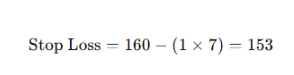
This accounts for normal daily fluctuations.
3. Adjust Based on Market Conditions
While the “ADR” provides a good baseline, you may need to adjust your stop loss based on the current market conditions. If the market is experiencing high volatility, you should increase your stop loss level. Conversely, if the market is calm and price action is tight, you could use a smaller multiple of the ADR to keep your stop loss tighter.
This dynamic approach ensures that your stop loss is not only based on historical volatility but also adapted to real-time conditions.
4. Combine with ATR for More Precision
The “average true range” (ATR) indicator can be used in combination with ADR to refine your stop loss placement. The “ATR” is similar to the “ADR” but takes into account gaps in price and provides a more precise measure of volatility.
To calculate a stop loss using the “ATR”, follow a similar process as with ADR, but base your stop loss on the “ATR” value instead of just the ADR. If you’re using the “ATR stop loss” method, you could apply a multiplier (like 1.5 or 2) to the ATR value to determine how far to place your stop loss from your entry price.
For example, if the “ATR” for the asset is 5 points and you decide on a 2x ATR multiplier, your stop loss for a long position would be placed at:

By integrating the “ATR” into your strategy, you add a layer of flexibility that accommodates sudden price spikes or gaps.
Why Setting Stop Loss Based on Average Daily Range Works
By using the “average daily range” to calculate at which the market might be expected to trade, we have a more logical method of setting a stop. Here’s why it works:
- Reduces Premature Stop Outs: So that you do not get stopped out by regular market noise, by taking into consideration an average daily range.
- Adapts With Market Conditions: As the ADR changes, your stop loss will change accordingly, depending on how volatile the market has been, your strategy will be accommodated.
- More Favorable Risk-Reward Ratio: If you put a stop-loss order on the ADR, you are assuring that the trade has a bit of leeway to play out, increasing the odds of your trade working out.
ATR Indicator and Its Role in Stop Loss Strategy
It’s another must-have work tool to place a stop loss based on average daily range. It computes an average range of prices for price fluctuations for a designated period and takes price gaps into account. This “ATR meaning” also matters as it allows traders to measure market volatility that they can then use to decide how tight or loose they should set their stop loss.
And that is when you apply the “ATR stop loss” method, but it gives a lot more precision in measuring how much risk you are taking on. The “ATR” can also be used to pinpoint potential prevent huge moves against your position can be accomplished by adjusting the stop loss to the current level of volatility. It’s particularly handy in markets that have sudden surges in volatility.
ATR’s Advantages Over ADR
ADRX vs. ATR. Both ADR and ATR are indicators of volatility, where ATR may prove advantageous under certain situations, due to momentum. For example, the ATR considers price gaps between trading sessions, the ADR does not. If you are trading a product with gaps, the ATR will effectively tell you where to put a stop loss; if you are trading something without gaps (like stocks), I don’t see it having much use.
ADR, by contrast, is more suitable for assets with less volatile price moves and smaller daily ranges. For more volatile assets or when markets are not trending, ATR is generally a preferable method for setting stop loss levels.
How to Combine ADR and ATR for Maximum Efficiency
The optimal stop loss location comes from combining “average daily range” with the “ATR” indicator. Where ADR gives you an idea of the entire daily trading range, ATR can be used to measure daily volatility and is more applicable for shorter periods before a shift in trends when the gaps between specific days begin to grow. Combining both will help you have a stop loss that is neither too tight nor too loose.
You can use the initial ADR calculation to do some quick calculations to assist in your trading decision about the potential for what would be enough room to capture a 3: R risk reward ratio likely. Then simply use the ATR to refine that initial calculation to make sure your stop is based on historical volatility as well as current market activity. This cautious approach increases the likelihood of successful trades and limits the risk of bad streaks.
Using ADR and ATR in Conjunction with Other Indicators
ADR and ATR in your stop loss strategy are most effective when you use your ADR and ATR in convergence with other technical indicators. For example, moving averages, Bollinger Bands, and RSI can be used to provide confirmation signals for your stop-loss placement. From these additional indicators, consider using them to confirm your stop loss and tighten your risk management.
The point taken here is that ADR and ATR are both important aspects towards your trading, but that they should also be part of your larger trading plan, which should incorporate: technical analysis, market sentiment, and price action.
Conclusion: How to Set Stop Loss Based on Average Daily Range
The use of the average daily range as a target or a stop becomes one of the most popular ways to manage the risk of any given trade. By considering the ADR, applying the current market environment for adjustment, and refining the stop loss with the “ATR” indicator, you can easily avoid too-tight or too-far stop-loss levels. Which will enable you to mitigate your risks based on the historical volatility of the asset you are trading, which minimizes the likelihood of you being prematurely stopped out, and it will increase the effectiveness of your trading.
For further exploration on this topic, check out the article Sell in May and Go Away, which covers market trends and volatility patterns and helps you understand how market behavior can influence your trading decisions.
Also, for more in-depth knowledge and courses on trading strategies, consider exploring my course on Key to Vision Investment.
Feel free to follow me on my Facebook page for the latest updates and trading tips!