
For tens of thousands of years, humans have lived a nomadic lifestyle, always moving in search of food, decent housing, and survival. There was no concept of real estate at that time. Yet later, when settlements started to form, people began to believe in the concept of land, and this eventually became the complex real estate system and the investment market we know today. The history of real estate, therefore, is not only about one society, but a story of many societies, the same as the history of economics, law, and the transformation of societies.
From the communal lands of the early tribes to the high-rise buildings in metropolises, real estate has affected how we live, trade, and build wealth. The article details the tabulation of the various stages through which real estate has passed, starting at its period of inception, proceeding through the regal and industrial times, and now to the world’s dominant industry.
The Dawn of Settlements: When Land Meant Survival
Before the coining of the phrase “real estate,” there were early human societies that existed as hunters and gatherers. Their existence was at the mercy of the environment, as animals moved in specific seasons and plants bloomed in different cycles. Eventually, around 15,000 BC to 30,000 BC, the planting of crops as the primary source of food (the seed of agriculture) occurred. At that point, they grew crops and domesticated animals, leading to the birth of towns, which are the roots of today’s cities.
This was the first form of land occupation itself. Nobody legally had full ownership of land, but everyone just possessed the land he or she used most of the time. The groups that were most capable of defending the sizable land at their disposal were the ones who held it, and the band of capable land occupants was that of the physically strong. The process of mere occupation by the strong and the influx of the population, and the demands of the people created the “history of land ownership,” which provided the present era with the opportunity it has enjoyed today.
From Tribal Chiefs to Kingdoms: The Rise of Property Control
More and more as communitiesgrewg and grew in complexity, tribal leaders took the authority of society. The figures—chiefs, elders, and warriors—began to control the piece of land, and reserved some parts for farming, some for dwelling, and some for spiritual needs. Thus, their power was often connected to the protectability of the land and people by it, which directly led to reassuring them as the legitimate ruling class.
Gradually, the tribal leaders were transformed into monarchs, emperors, and aristocrats. The land became the symbol of richness and strength and was often passed down to the next generation. As a result, the history of “land” and “real estate” became closely related terms with the concept of feudalism, where the initial working class of society (peasants) cultivated the land and gave their rent or taxes to those who were responsible for the lordship, i.e., landlords, nobles, or kings, in return for protection and livelihood.
The Feudal Era: Rent, Taxes, and Royal Land Grants
During the time the feudal system was at its peak, the majority of land was owned by either the king or the vassals. Only a permitted group of people were living on the land, while the hands of the permitted group were tied tightly by force of royal orders, a fixed lineage, and well-formed armies. This fact used to be unimportant unless the peasantry wished to become sub-tenants, live, and farm the land. This whole rent system introduced a new way of living—paying a fee for the right to use the property you do not own.
One way that the feudal system worked was that the lords of the fief could lease those territories to their agents, who, in return, by charging the tenants, allowed those persons to enjoy the land like it belonged to them. Those moments of the allocation of the land and the establishment of the ownership and the right of the landowners paint quite a colorful scene of the basis of tenancy law and property rights. However, even if the “real estate background” in those early times mainly belonged to the upper class, the emergence of such structures and the implementation of the ideas about the distribution, utilization, and transmission of lands were already there.
The Fall of Aristocracy and Rise of the Middle Class
The Enlightenment and the subsequent revolutions, especially those in Europe, dismantled the hereditary rule. The French Revolution, the independence of America, and similar events in the world rocked the global aristocratic status quo. As countries changed their political systems, the opportunity to own land was also made available to their citizens. The estates that were previously almost exclusively the domain of the royalty were now taken from them, sold, or distributed by the power of the people.
During this time, property ownership reached beyond nobles. A new class consisting of rich merchants and industrialists had come to be. These people, having garnered riches from business and the manufacturing sector, started to buy properties of their own. This is the stage that answers, for the most par,t the ‘how has real estate changed over the years’ question where ownership of property moved from inheritance to purchase and investment.
America’s Westward Expansion: Land for the Taking
In the annals of U.S. real estate, one of the most significant events was the Louisiana Purchase in 1803. The purchase expanded the land by 828,000 square miles and created a new land ready for settlement by millions of Americans.
The Homestead Act of 1862, like other laws concerning land, enabled citizens to take and cultivate up to 160 acres. The legislative actions not only formalized individuals’ right to own land but also tied it to the period when land in developed countries was nearly free, le l and societal improvements should have taken place. As a result, it reinforced the fundamental principle of the American Dream about property ownership serving as a representation of freedom, responsibility, and wealth.
The Industrial Revolution: Urbanization and Housing Demand
The change from agrarian economies to industrialized cities brought a huge change in the real estate sector. Rapidly, there was a massive movement of populations to the urban regions, generating an urgent need for residential, commercial, and industrial facilities. There was a great surge in factories, apartment buildings, and tenement houses. The change, in this regard, was not just about land owner shift, but it eventually became about land building, renting, and flipping as well as employing it as a financial leverage tool.
Given the explosion of the cities, the importance of zoning regulations, building codes, as well as property taxes,, not go unnoticed. It should be noted that this was the time when the modern, formal real estate market and related institutions came into being, including real estate agents and urban planning departments. What is more, these changes made the “history of the housing market” an entirely different, more organized, and regulated realm.
The Mortgage Revolution: Making Ownership Attainable
Early on, acquiring a home was a matter of somebody having the required capital to pay for it in full, which was the privilege of the wealthy alone. However, once the financial institutions and the governments realized the positive impact of ownership on the economic conditions, they designed lending systems that empowered ordinary citizens to seek homeownership through long-term loans.
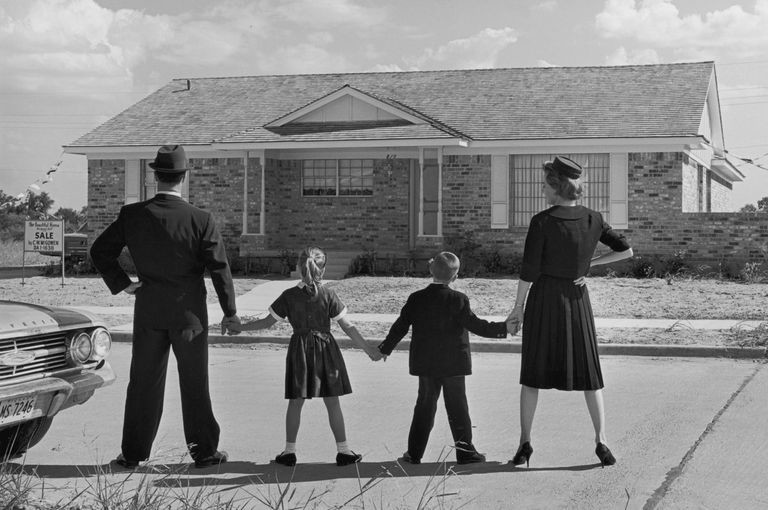
Home loans brought individual ownership of property within the reach of the middle and working classes. Federal Housing Administration (FHA) loans in the U.S. and later the GI Bill for ex-servicemen were among the government programs that significantly changed the idea of ownership. People understood that mortgages were the instrument via which they could make property a necessity rather than a luxury.
The 20th century was the period when suburban growth was most prevalent and most concentrated on single-family houses as the main market segment. This period played a big role in shaping the modern real estate business and the companies involved in it.
The Changing Role of Real Estate in the Investment World
Real estate became another kind of investment after the late 20th century. The wealthy individuals and institutions were no longer seeking to be house owners but rather acquiring properties for rental income, capital appreciation, and diversification accordingly.
The inception of REITs (Real Estate Investment Trusts) in the 1960s was a breakthrough that allowed access to investment opportunities without direct ownership. This meant that a fair amount of the society’s population would become beneficiaries of property revenue without necessarily owning entire buildings. It is the fact that the real estate market was boosted by a lot of speculation in the 1980s and the early 2000s that caused the occurrence of gains and, subsequently, bubbles in the market.
When the following query started popping up more frequently: What are realestate portfoliosr or real estate strategies?” it was clear that property ownership was no longer just for personal use but had become a leading financial vehicle.
Digital Era and Smart Real Estate: A New Frontier
The introduction of the internet had a major effect as the whole process was changed right from the way people could search for homes to how properties were marketed, sold, and even managed. Examples such as Zillow, Redfin, and Airbnb have made information and earning potential available to anyone.
In addition to that, technology has put up a further fight in real estate through the development of smart homes, virtual tours, blockchain-based property records, and AI-driven pricing tools. Not only is this often referred to as the PropTech (Property Technology) period, but it’s also completely changing how real estate transactions are being conducted.
More of the usual types of ownership are still prevalent, but combine the “real estate” revolutionary duo with digital real estate – virtual land in the metaverse, land records’ NFTs, and blockchain-based rental agreements can perfectly illustrate the change.
Globalization and the International Real Estate Market
The concept of the world being a global village has not only restricted the real estate business to local borders but has also had a significant impact on the overseas real estate sector through international capital flows, cross-border property rights, and global development companies, thanks to which it has now become a global market.
The paradigm shift in global real estate markets is represented by the ability of real estate markets to disperse money to areas with appreciating value, security, etc., regardless of their physical location. Wealth pours into the market, and it is reshaping the industry altogether.
Real Estate in Times of Crisis: Bubbles and Recoveries
Just like any other field, real estate is susceptible to market movements that create crises. The 2008 financial crisis, fueled by subprime mortgage lending,,n g was the beginning of global housing market mayhem. The cascading events led to millions of people losing their homes, followed by the collapse of many banks.
Such crises also gave birth to a range of fragile issues in addition to the above. The changes include implementing new laws, being more careful in the financial industry, and the formation of affordable development, green housing, and financial literacy among buyers came back stronger than ever.
The pandemic was yet another expression of the market’s endurance. Remote work not only turned suburban areas into hot spots but also saw the business of virtual reality and augmented reality, and the Internet of Things technology boom.
The Future of Real Estate: Sustainable, Smart, and Shared
Among the several key trends and themes that are expected to shape the new era of real estate, we find the ideas of sustainability, affordability, and technological integration. An indication of the trend is the widespread acceptance of energy-efficient initiatives such as the construction of zero-energy homes.
Ownership has seen very interesting times in the past and continues to evolve. The idea of co-living, co-ownership, and fractional investment is changing property access these days, especially dramatically, making it favorable for the people belonging to the younger generation who are encumbered with the unsettling loan of acquiring a good education and housing issues that are on the rise.
Furthermore, the role of artificial intelligence and data analytics in decision-making is immense, while city planners have concentrated their efforts on smart cities, which are integrating technology, accessibility, and environmental mindfulness.
Conclusion: Ownership Then and Now
The history of real estate takes us from caves to castles to condominiums and is the story of human life and human ststrivingor better. Its beginning was just a simple claim for fertile land, but it grew into a system of property, investment, and policy, which is now very complicated.
At present, real estate deals such as buying, selling, renting, or leasing are not only rights but also the duties of people. They have the power to change the lives of individuals, run economies, and speak of the issues ranking on society’s priority list. The chance of controlling the land was previously reserved only for those who considered themselves the elites, but now it has become a matter related to safety, prosperity, and one’s freedom to pursue one’s dreams.
As we keep on inventing and adjusting, real estate will always be a part of the human journey to progress that is rooted deep in history, but also growing together with the changing world.