
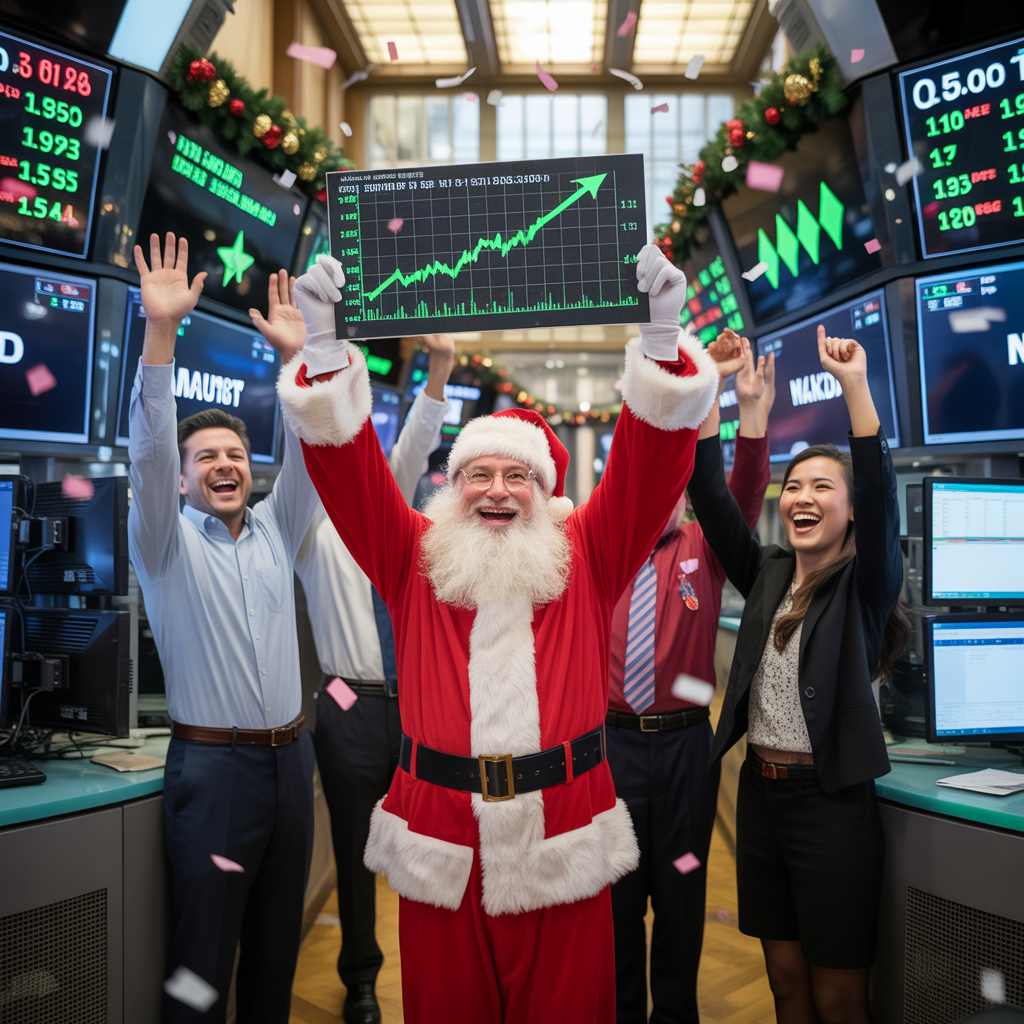
Every year, market watchers pay close attention to how stocks behave during the final stretch of December and the first days of the new year. This short window has gained a reputation for producing stronger-than-usual returns, a pattern widely recognized as the Santa Claus rally.
Although this seasonal effect has appeared many times over several decades, understanding what drives it and how investors should interpret it is more useful than simply assuming it will repeat. A closer look at historical data, common explanations, and practical investment implications can help clarify what this pattern represents and what it does not.
Understanding the Santa Claus Rally
A Santa Claus rally refers to a specific seven-trading-day period: the last five trading days of December and the first two trading days of January. Some traders also observe how markets behave during the stock market Christmas Eve, since it falls within this year-end stretch.
This phenomenon is often treated as part of a broader group of seasonal market trends. While the name is light-hearted, the underlying concept is based on measurable historical performance rather than folklore. Many refer to it interchangeably, sometimes even calling it a Santa Claus rally, but the meaning generally remains the same: unusually strong returns during a specific holiday window.
Why the Pattern Matters
Market patterns earn attention only when they show measurable consistency. Decades of data reveal that the market has frequently produced positive returns during this short period, more often than a random seven-day span during the year.
Because of this, some analysts use the year-end rally as an informal sentiment gauge. Strong performance suggests optimism, while a disappointing outcome prompts discussions about potential weakness ahead. However, like any short-term pattern, it should be viewed as one data point, not a long-term forecast.
Historical Performance of the Santa Period
Historical statistics show that the seven-day holiday window has delivered positive returns far more often than negative ones. Average gains around this time have typically clustered between 1% and 2%, though the exact figure depends on the index and period examined.
Several market commentary platforms track the annual outcome of the stock market Santa Claus rally. When the period produces gains, traders often point to improved sentiment and seasonal buying strength. When it does not, attention shifts to whether investors are becoming cautious heading into the new year.
The short duration and recurring trend make this seasonal effect unique. While markets do not move in predictable patterns year-round, the consistency of this specific window has made it one of the most discussed seasonal indicators in modern market analysis.
What Drives the Santa Claus Rally?
Understanding the most common explanations
Although there is no single definitive cause, several factors routinely come up when explaining this holiday effect:
1. Light institutional activity
Many large trading desks scale back operations late in December. With fewer large orders from institutional players, smaller trades can have a stronger-than-usual influence on price movement.
2. Increased retail activity
Retail investors tend to be more active during the holidays. This audience also tends to be more optimistic, contributing to potential buying strength.
3. Holiday sentiment
Positive consumer spending, festive optimism, and general financial confidence can create a mild bias toward risk-taking.
4. Bonus and tax-driven positioning
Some investors deploy year-end bonuses into the market or make final adjustments for tax efficiency. This additional activity can create upward momentum.
5. Behavioral and technical factors
Patterns can reinforce themselves; traders who expect a rally may buy in anticipation, contributing to its continuation.
These combined influences often help explain why Santa Claus rally stocks become a focus every December. Yet none of these reasons guarantees that the effect will appear each year.
How December Typically Behaves
The broader month of December has a long-standing reputation for stronger-than-average performance. Discussions around December stock trends often highlight increased consumer spending, portfolio rebalancing, and lower volatility.
However, the Santa period specifically refers to the short seven-day stretch, not the entire month. Even if December is weak or mixed overall, the final trading days can still show strength.
January, Momentum, and Related Seasonal Indicators
The early days of January are part of the year-end rally window, and this overlap ties the Santa pattern to several other seasonal beliefs:
The January Effect
Smaller companies sometimes experience stronger returns early in the year, though this trend has weakened over time.
The January Barometer
This idea proposes that the direction of January as a whole may reflect the market’s general trajectory for the rest of the year.
Combined signals
Some analysts watch the year-end rally, the first week of January, and full-month January returns together to assess early-year sentiment.
These seasonal signals are guidelines rather than rules. They may offer insight into market mood, but they should not replace broader fundamentals.
Should Investors Trade the Santa Claus Rally?
Seasonal patterns can be interesting, but they must be approached with caution. For most investors, the Santa effect should not serve as a standalone trading strategy.
Reasons to be cautious:
- The pattern does not appear every year.
- Short-term movements are easily disrupted by unexpected news.
- Overreliance on seasonal timing can lead to unnecessary risk-taking.
- Transaction costs and spreads can widen during thin holiday trading.
Investors with long-term goals, such as retirement planning or diversified portfolio growth, typically benefit more from steady contributions and disciplined allocation than from tactical attempts to capture a Santa Claus stock rally.
When the Pattern Fails
There have been years when the market has not produced a holiday rally. When this happens, analysts often examine the broader environment for clues:
- Weak consumer spending
- Rising interest-rate concerns
- Geopolitical stress or economic uncertainty
- Reduced liquidity
- Shifts in corporate earnings expectations
A failed Santa pattern does not guarantee a weak upcoming year, but it does serve as a potential sentiment indicator. Traders sometimes view it as a sign that investors are more cautious than usual.
Market Segments Influenced by Holiday Trading
Different parts of the market behave differently during the Santa window:
Large-cap stocks
These companies often benefit from stable investor expectations and higher liquidity.
Growth and consumer-focused sectors
Some benefit from upbeat holiday sentiment or positive spending data.
Small caps
These can be more sensitive to year-end tax positions and retail trading behavior.
Tech-heavy indices
Often reflects momentum and sentiment shifts more visibly.
This is one reason why headlines frequently track Santa Claus rally stocks and monitor whether strength is broad-based or concentrated in only a few areas.
Useful Guidelines for Handling the Santa Period
1. Understand the history—don’t chase it
Past tendencies do not guarantee future performance.
2. Keep the big picture in mind
Macroeconomic trends, earnings strength, and policy decisions matter far more.
3. Focus on risk management
Decide how much risk is appropriate before taking any position.
4. Avoid emotional reactions
Seasonal stories can cause unnecessary excitement or fear.
5. Treat the rally as information
It is a sentiment gauge, not a signal to overhaul an entire portfolio.
Conclusion
The Santa Claus rally remains one of the most talked-about seasonal patterns in modern market analysis. Decades of data show that the final days of December and the first days of January often bring a mild upward bias to stocks. However, this pattern should be treated as an interesting historical tendency, not a guaranteed event or a tool for predicting the full year.
For most investors, the Santa period presents an opportunity to review risk levels, reflect on upcoming market conditions, and refine financial plans. For short-term traders, it may offer potential openings, but only when supported by careful discipline and proper risk management.
Seasonal patterns can add context, but long-term strategy and consistent decision-making remain the foundation of successful investing, during the holidays and throughout the entire year.
Further Reading
Santa Claus Rally: What It Is and Means for Investors
Santa Claus Rally: Meaning, History & Impact on Investors.
Mastering the Santa Claus Rally: Seasonal Profits in Late December 2025?