
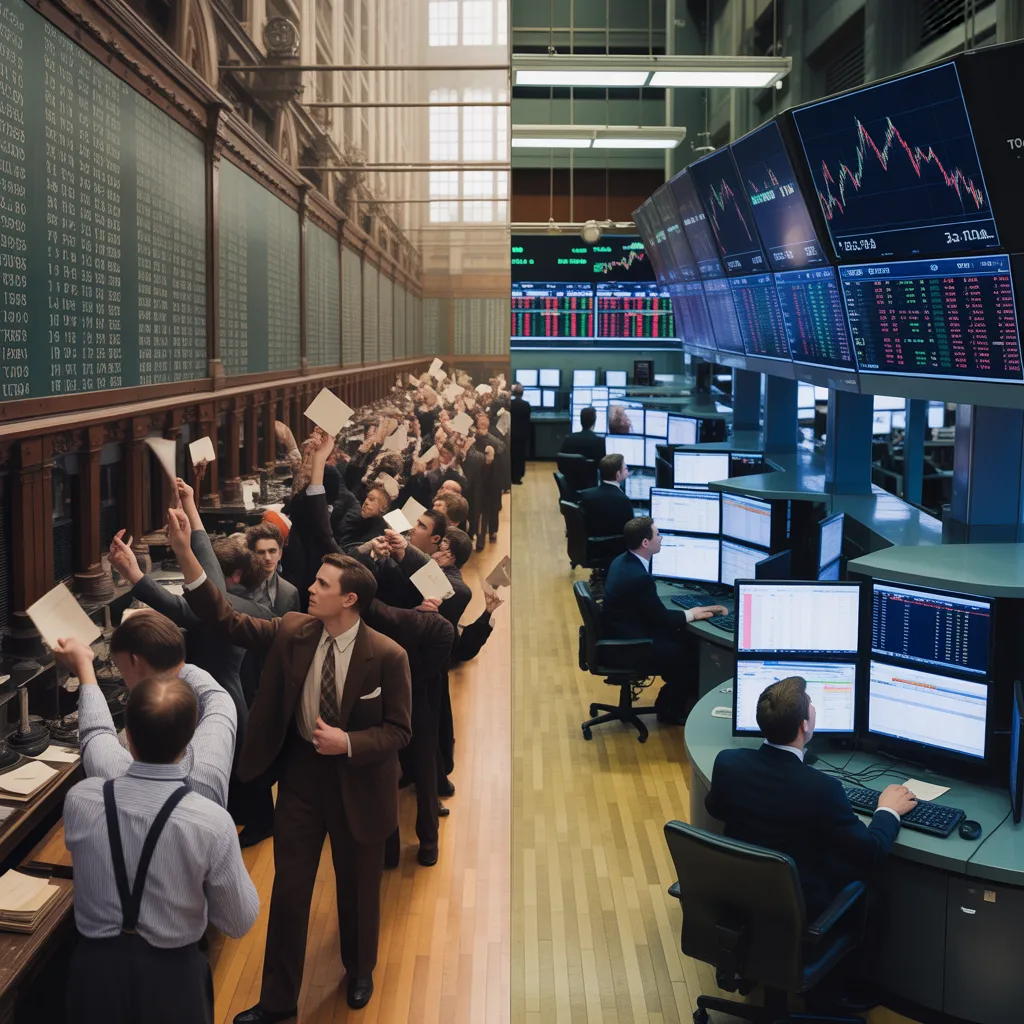
Many investors and students ask how have stock exchanges changed over time and why those changes matter today. The stock market looks modern now, with apps and instant trades. But it did not start this way. It began with small groups of traders meeting in person. Over centuries, stock exchanges moved from coffee houses to large trading floors. Then they shifted again to computers and global networks. Rules became stricter. Technology replaced shouting brokers. Access expanded from wealthy elites to everyday investors. Today, markets operate in seconds, sometimes milliseconds. Understanding this evolution helps explain how risk, transparency, and opportunity developed. It also shows why modern markets work the way they do.
This article explains the history, structure, and major turning points that shaped stock exchanges into what we see now.
Early Trade and the First Organized Markets
Long before modern exchanges, merchants traded goods and debts in open markets. In Europe during the 1500s and 1600s, traders began selling shares in trading companies. One of the first well-known markets formed in Amsterdam.
People often ask, when was stock market invented. There is no single exact date. However, many historians point to the Dutch East India Company in 1602 as a key milestone. It issued shares to the public. Investors could buy and sell those shares. This created one of the first organized stock markets.
These early exchanges were simple. Traders met face to face. Deals were recorded by hand. Information moved slowly. Prices changed based on rumors and shipping news.
But even then, the core idea existed. Investors pooled money. Companies used that money to expand. Profits were shared.
What Is a Stock Exchange?
To understand change, we need a clear stock exchange definition. A stock exchange is a regulated marketplace where securities like stocks and bonds are bought and sold. It connects buyers and sellers. It sets rules. It provides price transparency.
If someone asks what is a stock exchange, the answer is simple. It is a structured system that allows companies to raise capital and investors to trade ownership shares.
Early exchanges had limited oversight. Over time, governments added rules to prevent fraud and market abuse. Regulation became central to trust.
Without trust, markets fail.
The Birth of Modern Exchanges
The 18th and 19th centuries saw major development. In 1792, traders signed the Buttonwood Agreement in New York. This led to the formation of what became the New York Stock Exchange.
Many wonder, when did the stock market open in the United States. The NYSE traces its roots to that 1792 agreement. It formally grew into a structured exchange in the early 1800s.
During this time:
- Trading floors became official spaces
- Membership systems formed
- Standardized contracts were introduced
- Governments increased oversight
Industrial growth fueled expansion. Railroads, steel companies, and banks issued shares. Investors funded economic growth.
But markets also faced crashes. The Panic of 1907 and the Great Depression showed the dangers of weak regulation.
The Impact of Regulation
After the 1929 crash, the United States introduced major reforms. The Securities Act of 1933 and the Securities Exchange Act of 1934 created stronger disclosure requirements.
Other countries followed similar paths. Exchanges adopted stricter listing standards. Companies had to publish financial statements.
This period changed exchanges in three ways:
- More transparency
- Stronger investor protection
- Increased government oversight
Markets became safer, though not risk-free.
From Trading Floors to Screens
For much of the 20th century, stock exchanges relied on physical trading floors. Traders stood in pits. They shouted orders. Prices were written on boards.
Then technology changed everything.
In the late 20th century, electronic trading systems emerged. The Nasdaq, founded in 1971, was one of the first electronic exchanges. It reduced reliance on physical presence.
By the early 2000s, many exchanges moved fully electronic.
This shift led to:
- Faster execution
- Lower trading costs
- Global access
- Increased liquidity
And it reduced the need for human intermediaries.
Today, most trading happens through computers. Algorithms process orders in milliseconds.
Globalization and Market Expansion
Stock exchanges used to operate mostly within national borders. That changed in the late 20th century.
Technology allowed cross-border investment. Investors in one country could buy shares listed elsewhere.
This led to the rise of global giants. Some of the largest stock exchanges today include:
- New York Stock Exchange
- Nasdaq
- Shanghai Stock Exchange
- London Stock Exchange
- Tokyo Stock Exchange
These largest stock exchanges handle trillions of dollars in market value.
Globalization increased competition between exchanges. It also created 24-hour trading cycles across time zones.
The Rise of Retail Investors
For many decades, investing was limited to institutions and wealthy individuals. Brokerage fees were high. Access required personal brokers.
The internet changed that.
Online trading platforms allowed individuals to open accounts easily. Fees dropped. Information became free and instant.
In the 2010s and 2020s, mobile apps expanded access even more. Retail participation increased sharply during events like the COVID-19 pandemic.
This changed market dynamics. Retail investors began influencing short-term price movements.
But it also raised concerns about speculation and volatility.
High-Frequency Trading and Algorithms
Modern exchanges now rely heavily on automation. High-frequency trading firms use complex algorithms. These systems execute trades in fractions of a second.
Supporters say this increases liquidity and efficiency. Critics argue it creates instability.
Flash crashes, like the one in 2010, showed how fast automated systems can impact markets.
Still, exchanges continue refining safeguards. Circuit breakers pause trading during sharp declines.
Technology improved speed. It also introduced new risks.
Transparency and Data in Modern Markets
In earlier centuries, information traveled slowly. Investors relied on letters and newspapers.
Now, data is real-time.
Financial statements are published online. Earnings calls are streamed. Market prices update instantly.
Exchanges publish trading volumes, price movements, and order data. Investors can analyze markets from home.
Transparency increased. But information overload also became a challenge.
Investors must now filter massive data flows.
The Role of Regulation Today
Regulation continues evolving. Governments monitor insider trading, market manipulation, and disclosure practices.
Global coordination improved after the 2008 financial crisis. Risk management standards became stronger.
Exchanges also focus on cybersecurity. Digital systems must be protected from hacking.
Modern markets balance innovation with control. Too little regulation creates risk. Too much can reduce efficiency.
Finding the balance remains an ongoing process.
The Shift Toward Digital Assets
In recent years, digital assets like cryptocurrencies introduced new types of exchanges. These platforms operate differently from traditional stock exchanges.
Some investors now trade digital tokens alongside stocks.
Traditional exchanges are adapting. Some explore blockchain settlement systems. Others consider listing crypto-related products.
The structure of trading continues to evolve.
But the core idea remains. Buyers and sellers meet through an organized system.
What Has Stayed the Same
Despite centuries of change, certain elements remain constant:
- Companies raise capital
- Investors seek returns
- Risk and reward exist
- Prices reflect supply and demand
Human psychology still influences markets. Fear and greed still shape decisions.
Technology changed the speed. Regulation improved fairness. Access expanded participation.
But the foundation did not disappear.
Final Thoughts
Stock exchanges have changed from small gatherings of merchants to complex digital networks handling global capital flows. They evolved through industrial growth, regulation, technology, and globalization.
Early markets were local and manual. Today, trading is electronic and global. Access moved from elite circles to everyday investors. Oversight strengthened after major crises. Technology increased speed but introduced new risks.
Understanding how exchanges evolved helps explain modern investing. It shows why transparency matters. It shows why regulation exists. And it shows how technology continues shaping markets.
Markets will likely keep changing. New tools will emerge. Rules will adapt. But the purpose remains clear. Connect capital with opportunity.
And that basic function has survived for centuries.