
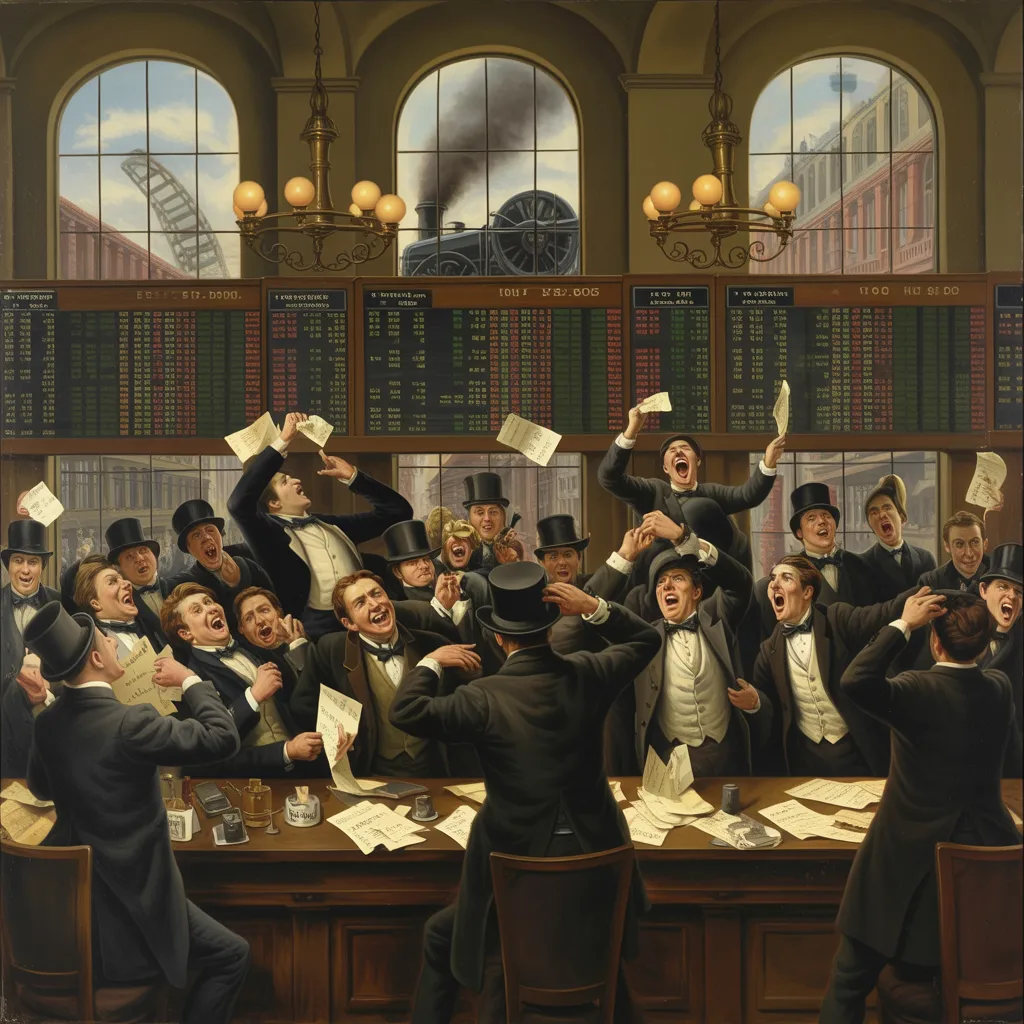
In the mid-1840s, Britain fell in love with a new idea: railways would transform everything, trade, travel, cities, and fortunes. Investors didn’t just believe railways were useful; they believed railway shares were almost guaranteed wealth. Money poured in, new companies sprang up at speed, and Parliament was flooded with proposals for fresh lines crisscrossing the country.
What followed is now known as Railway Mania, an extraordinary episode of mass enthusiasm that looked, in many ways, like modern bubbles in tech, property, and hot new “can’t-miss” trends. Yet it also left behind something many bubbles don’t: a foundation of infrastructure that reshaped the economy for decades.
The Spark: A New Technology Proves Itself
Railway Mania didn’t appear out of nowhere. Its roots trace back to a practical breakthrough: the opening of the Liverpool and Manchester Railway in 1830, widely seen as the first successful modern inter-city passenger line. At the time, Britain was accelerating into the industrial age. Manufacturers needed to move coal, iron, cotton, and finished goods quickly and reliably. Canals and roads helped, but they were slower, more limited, and often weather-dependent.
Early scepticism was common. Many doubted passengers would abandon familiar horse-drawn travel for loud, fast machines that seemed risky and uncomfortable. But reality changed minds quickly. The Liverpool–Manchester route attracted crowds, proved demand for passenger travel, and delivered profits that made investors take railways seriously.
That success did something powerful: it turned railways from a technical curiosity into an investable story. It showed that a railway could generate strong revenue from both freight and passengers, and it suggested that similar lines might flourish across the country.
Conditions That Turned Interest Into a Frenzy
Big bubbles rarely have a single cause. Railway Mania grew out of a mix of genuine opportunity and financial fuel.
One key ingredient was easier money. In the early 1840s, borrowing conditions became friendlier, lowering financing costs and helping investors feel more confident about backing long-term projects. Another accelerant was access: railway shares could often be bought with only a small upfront payment, commonly a 10% deposit, bringing the market within reach of a broader middle class.
That detail mattered. When you don’t have to pay the full price immediately, it becomes far easier to “join in” before prices rise further. It also changes behaviour: people start thinking in terms of fast gains rather than long-term cash flows. In other words, the market becomes primed for speculation boom dynamics, where the excitement feeds itself.
As more investors piled in, rising prices seemed to “confirm” that railways were the future. And because railways were genuinely transformative, it was hard for many to separate the real innovation from unrealistic expectations.
Promotion, Hype, and the Information Problem
As the mania heated up, railway companies marketed themselves aggressively, especially through newspapers, a fast-growing medium at the time. Ads and promotional materials promised prosperity, national progress, and exceptional returns. In some publications during the peak period, railway advertising consumed an enormous share of available space.
But the public’s ability to evaluate claims was limited by a major issue: accounting and disclosure standards were underdeveloped. There was no modern framework requiring consistent reporting, transparent assumptions, or independent verification. Auditing existed in early forms but wasn’t widespread.
That created a classic bubble environment:
- bold projections were easy to publish
- risks were easy to minimise or ignore
- ordinary investors had little reliable data to compare companies
- “success stories” spread faster than careful analysis
Some promoters were simply optimistic. Others were far worse. The era produced figures like George Hudson, the so-called “Railway King,” who became hugely influential and reportedly used methods that resembled a Ponzi-style approach, paying dividends from company capital rather than genuine operating profits.
When hype meets weak disclosure, markets can drift from investment into something closer to gambling. In today’s language, this is what a railway bubble looks like: a story everyone believes, valuations racing ahead of fundamentals, and too little clarity about what’s real.
Parliament’s Role: Permission Without a Plan
Railways were private ventures, but the state mattered enormously because new lines required legal approval and land rights. Parliament’s approach was, at least early on, largely permissive. Lawmakers focused on approving routes rather than enforcing strict viability checks or coordinating a national strategy.
During the height of the planning frenzy, hundreds of proposals poured in. In 1845 alone, the government authorised around 3,000 miles of track, roughly as much as the previous 15 years combined. That number captured the mood: railways weren’t just expanding; they were multiplying at historic speed.
Decision-making was also fragmented. Multiple parliamentary committees assessed projects region by region, which made it easier for proposals to slip through without being weighed against a coherent national network plan.
And there was an even more uncomfortable factor: incentives. Many MPs had exposure to railways through investments or relationships. When regulators and lawmakers benefit from the boom, the system can become less critical at precisely the moment it needs to be most cautious. This dynamic helped inflate what we now call british railway mania into a nationwide phenomenon rather than a contained sector trend.
Peak Mania: When Investment Becomes the Economy
By the mid-1840s, railway enthusiasm reached a scale that’s hard to imagine today. Plans were grander, valuations were richer, and new companies arrived in waves.
A striking statistic captures how enormous it became: at its peak, railway investment surged to around 7% of GDP, roughly half of total investment in the economy at the time. That means railways weren’t just a popular trade; they dominated capital allocation.
This is where bubbles become dangerous. When a single theme absorbs too much money, the economy becomes vulnerable to disappointment. If returns fail to match expectations, the damage spreads beyond speculators to households, businesses, and credit markets.
And inevitably, returns couldn’t meet the most optimistic narratives, not for every line, not for every company, and not at the pace investors demanded.
The Bust: When Optimism Meets Reality
Railways were revolutionary, but they were also expensive, complex, and slow to build. Many proposed routes were duplicates, impractical, or financially weak. When construction realities collided with speculative pricing, confidence started to crack.
A bust doesn’t need a single trigger. Often it’s a shift in sentiment:
- investors realise profits will take longer than promised
- new share issues dilute returns
- costs rise beyond early estimates
- dividends disappoint
- credit conditions tighten
Once prices stop rising, the logic of the mania collapses. Late investors who bought near the top often face the harshest outcome: they discover that “paper gains” were never the same as sustainable income.
For many households, the pain was real. People who entered with small deposits could still be liable for additional payments later, depending on how shares were structured. When confidence evaporated, the market could turn from excitement to obligation in a brutal way.
This is why Railway Mania is often described as a railroad bubble even though Britain uses “railway” more commonly: the pattern is recognisable anywhere, innovation sparks belief, belief becomes overconfidence, overconfidence becomes pricing fantasy, and pricing fantasy eventually collapses.
What Railway Mania Left Behind: Ruin and a Rail Network
Here’s the twist that makes Railway Mania especially important: despite the financial wreckage, the country did not walk away empty-handed.
By 1850, Britain had roughly a 6,000-mile rail network, new infrastructure that became the backbone of transport. It accelerated the movement of goods, connected industrial hubs, expanded labour markets, and helped reshape everything from pricing to commuting patterns.
That’s a crucial distinction. Some manias leave almost nothing of lasting value. Railway Mania, by contrast, helped build a physical system that supported growth long after the bubble burst.
This is why it can be compared to later infrastructure-heavy booms where investment got ahead of profits but still produced enduring assets. The capital cycle was chaotic, but the tracks remained.
Practical Takeaways: How to Spot a Bubble Pattern
Railway Mania may be a 19th-century story, but its structure still shows up in modern markets. If you want to extract something useful from the history, look for patterns rather than dates.
Here are common warning signs, then and now:
- A compelling technology narrative becomes a guarantee of profits
- Easy access to leverage or low upfront payments expands risk-taking
- Marketing overwhelms analysis, and scepticism is mocked
- Information quality is poor, and auditing/standards lag behind innovation
- Regulators enable growth but fail to enforce discipline
- Everyone has a success story, and “it’s different this time” becomes common language
- The theme consumes the economy, pulling capital away from everything else
None of these signs proves a bubble by itself. But when several appear together, and prices race ahead of realistic cash flows, it’s wise to slow down and ask harder questions.
Conclusion: A Bubble That Built Something Real
Railway Mania is a reminder that bubbles aren’t always pure delusion. Sometimes they form around a real breakthrough. Railways truly were transformational, and Britain’s economic future genuinely benefited from them.
But the mania also shows how quickly healthy enthusiasm can mutate into a railroad boom mindset where prices rise simply because people expect them to keep rising. That’s the danger: markets stop measuring value and start measuring excitement.
The lasting lesson is uncomfortable but useful: it’s easy to recognise a bubble after it bursts, and far harder while you’re living inside it. The best defence is not cynicism, it’s discipline. The next time a revolutionary story dominates headlines and valuations surge, the question isn’t “Is this innovation real?” It’s “Are expectations realistic, and is the market paying too much for the dream?”